Foundry One
First production deployment of the gantry extruder: autonomous survey to sealed 1,800 ft² shell in 41 hours, geopolymer mix, two-person finishing crew. Sonoran Corridor, AZ.
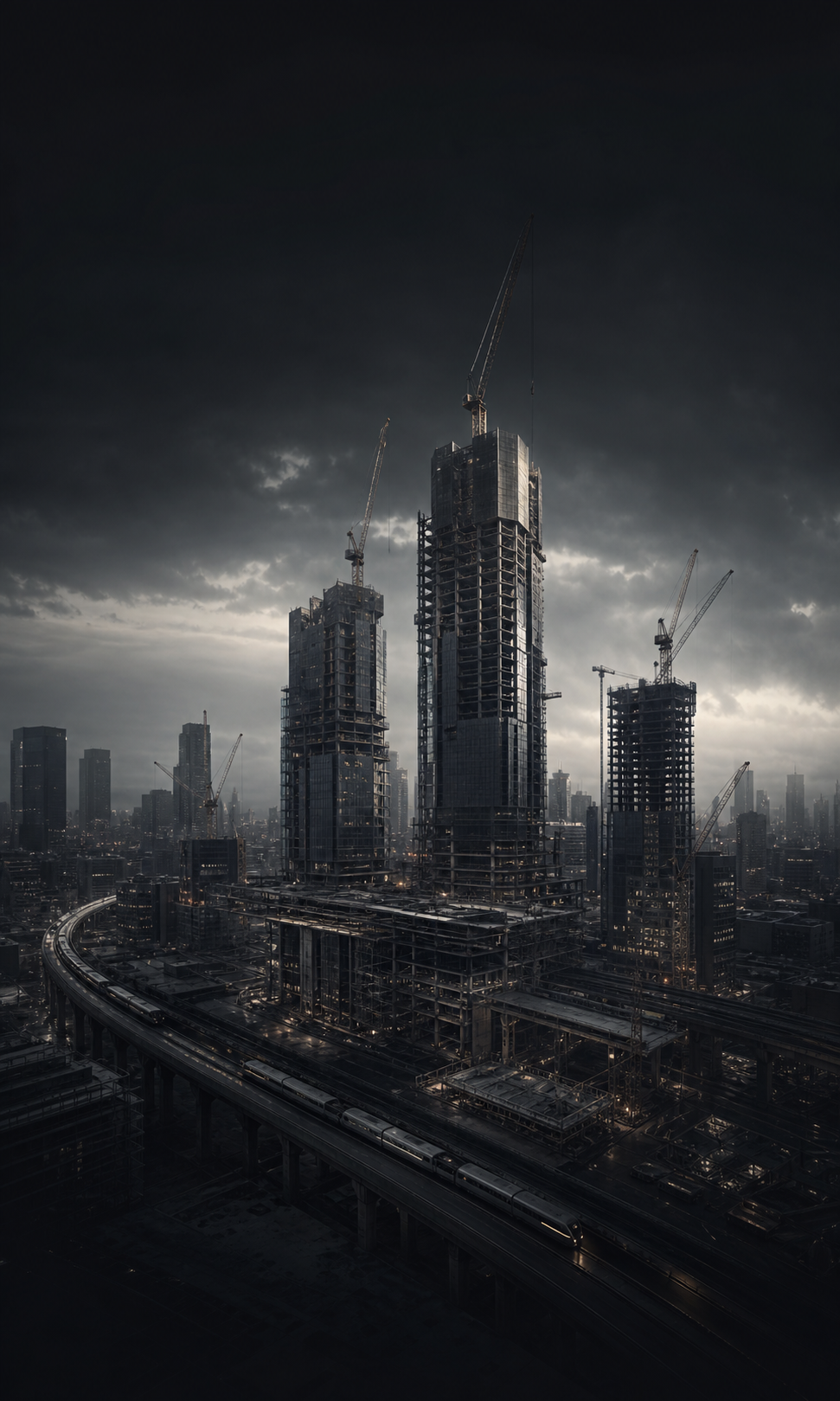
Segal Development designs, prints, and deploys autonomous 3D-printed buildings and self-sustaining communities — on Earth and in space. A building is treated as a print job: surveyed, modeled, and extruded by autonomous machines from material found on site.
One algorithm, different boundary conditions. Earth and Mars are the same problem with different gravity, atmosphere, and feedstock — solved once, re-skinned per environment. The only number that matters is time-to-habitation, compressed from years to days.
The Ten Fold acquisition adds the second deployment mode: pre-engineered buildings that transport at trailer size and unfold under their own power into full facilities in minutes — no foundations, no crane, one operator. Print where you stay; unfold where you move.
Gantry- and arm-mounted extruders lay low-carbon walls contour by contour at architectural scale, with closed-loop quality control on every layer. ±3 mm layer placement tolerance.
Site-blended geopolymer binders replace Portland cement at strength parity — 60% less embodied carbon, zero batch plants trucked to site.
Autonomous LiDAR and photogrammetry resolve the site to millimeters; constraints compile to a structural model and straight to machine toolpath. No manual redraw between survey and machine.
Coordinated multi-machine fleets print, place, and finish in parallel across a single footprint — the path from one structure to a community. In validation at Greywater Commons.
In-situ resource utilization fuses local regolith into structure and shielding; sulfur-concrete binders set in vacuum and cold. Nothing load-bearing is launched from Earth.
Five unit classes, TF-MICRO to TF-80: buildings that transport at trailer size and unfold into ~3× their footprint in under 10 minutes. No foundations, no crane, one operator.
First production deployment of the gantry extruder: autonomous survey to sealed 1,800 ft² shell in 41 hours, geopolymer mix, two-person finishing crew. Sonoran Corridor, AZ.
Containerized printer fleet validating time-to-habitation under field conditions: 6-unit permanent shelter cluster with no fixed power, no batch plant, no site office.
24-home off-grid community in the Nevada high desert — swarm sequencing across a shared footprint with closed-loop water and solar designed in, not bolted on.
Lunar-analog sintering testbed: simulant feedstock in vacuum-chamber conditions, de-risking binder chemistry, layer adhesion, and shielding density before flight.
Reference architecture for a cislunar habitat that lands, surveys, and prints itself — a pressurized, shielded shell standing before the first crew leaves Earth.
Orbital systems and launch. Space infrastructure and exploration.
Autonomous aircraft and airships.
Maritime hulls and offshore systems.
Cross-domain defense systems.
Quantum intelligence and analytics.
Autonomous robotics.
The operating system for the network.
Hardware and components.
Sustainable energy.
Advanced manufacturing.
Food and land systems.
Longevity and biofabrication.
Every part, one keystroke away.
Story and signal.