· Kevin Michael Segal
The Reach Of Our Ambition
To everyone who believes that the future can be built with greater imagination and greater care: that belief is the reason for Segal Industries. I am writing in 2026 with a clear conviction about the work ahead. We need machines that expand what people can make, infrastructure that opens new possibilities, and technology that remains understandable to the people it serves. The scale of that ambition reaches from a component in a workshop to a building, an aircraft, a vessel, and a spacecraft. It asks us to look at what exists today and take responsibility for the next useful step.
Our direction spans aerospace, aeronautics, maritime systems, defense, intelligence, robotics, computing, electronics, energy, fabrication, agriculture, health, supply, media, and development. Each field has its own demands. Together they offer a way to examine the systems on which modern life depends and the interfaces where progress can open another horizon. I want Segal to pursue that breadth with a builder's instinct and an engineer's respect for the work required.
Where The Instinct Began
My beginnings were humble. In Los Angeles, I found an early commercial talent through software design, building websites for clients I found on Craigslist while I was still in middle school. The work taught me to listen to an ambition and give it a form someone could use. Other experiments moved beyond the screen. I built a hovercraft for the seventh-grade science fair and later created a plastic-bottle recycling system that turned discarded material into printable filament. Those projects carried the same question: what can I make from the knowledge and materials in front of me?
During the COVID-19 pandemic, my parents' garage became the place where I designed and built the first Segal CNC and laser-cutting machines by hand. The frame, movement, electronics, and software had to become one working machine. That experience reinforced the importance of understanding the complete system. My studies in Architecture, Mechanical Engineering, and Product Design gave me complementary ways to approach that task, from the scale of a mechanism to the scale of a place.
The Discipline Of The Complete System
A system reveals itself through its connections. A fabrication machine needs material preparation, a control interface, inspection, maintenance, and someone prepared to operate it. An aircraft needs a route and a ground turn. A building needs power, water, communications, and equipment that can be reached when it needs attention. These relationships are where the breadth of our interests becomes practical. I want the people working across Segal to be able to follow a requirement from its original purpose into the components, software, procedures, and responsibilities that make it useful.
Integration also requires humility. The expertise needed to assess a vessel differs from the expertise needed to assess a biological technology or a spacecraft. A common identity should support collaboration while preserving those differences. The work must earn confidence through the evidence appropriate to its subject. We can share a discipline of clear requirements, careful interfaces, and understandable decisions while allowing every program to follow the technical path it actually needs. That combination gives a broad industrial ambition a foundation strong enough to examine.
An Infrastructure For Space
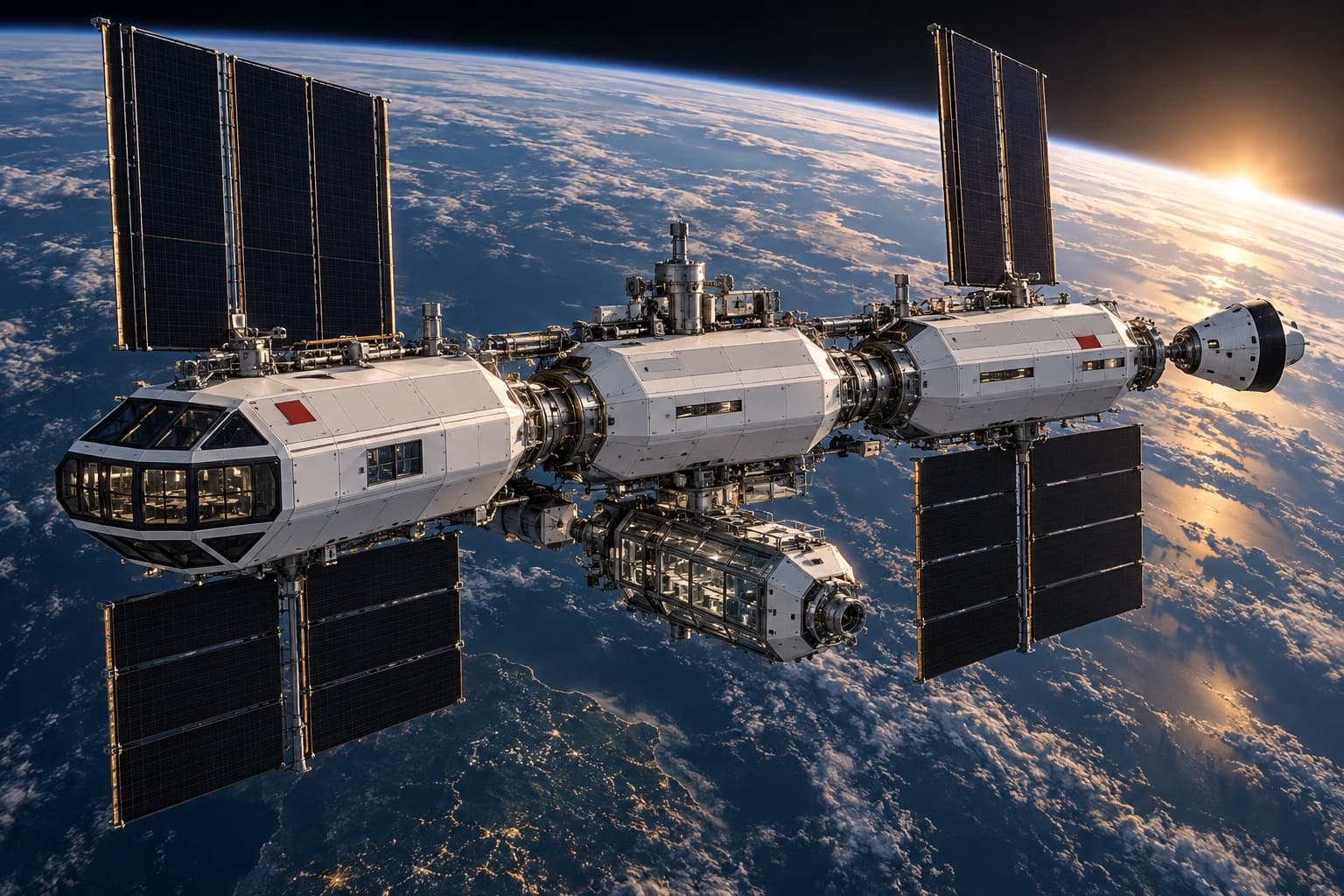
Space development has a particular place in my imagination because it asks us to build beyond the environments that already support us. A mission needs a vehicle, and it also needs power, communications, thermal management, software, ground support, and a plan for what happens next. The farther the ambition reaches, the more important those relationships become. Stations, surface nodes, transfer vehicles, and exploration systems introduce a continuing question about how future activity can be supported and extended. I want to pursue the equipment and infrastructure that can give that activity a more capable beginning.
The work on Earth belongs in that vision. Fabrication, robotics, computing, energy, and construction each contribute ways of understanding how complex systems are made and maintained. Their specific environments remain different, and those differences require serious engineering. The opportunity lies in carrying a deeper understanding between disciplines: how to manufacture an assembly, observe a condition, manage a dependency, or support a person performing a difficult task. An enduring space future will need both extraordinary vehicles and a coherent industrial foundation around them.
Technology In Service Of Place
The Philippines is part of my maternal ancestral background, and my interest in its future has a personal dimension. I am pursuing building modernization and the use of AI and large-scale data systems to modernize government and enterprise activity there. The starting point is the people carrying the responsibility for a service: the records they rely on, the decisions they make, the places where they work, and the people who depend on the result. Technology becomes meaningful when it helps that real work become more understandable and more capable.
The same concern connects my early home automation work with my wider interests today. I designed sensors and equipment for my own use and later for private residential and commercial clients. A system had to fit its setting and the person using it. My work in financial infrastructure follows a related practical question about stablecoin-to-fiat adoption and private cryptocurrency transfers: how can advanced technology connect with everyday economic activity? In every case, the task is to understand the whole journey and the responsibilities carried at each stage.
How We Will Earn The Right To Build
Ambition gives a project direction. Evidence gives the next decision a foundation. I want Segal's work to make both visible. A program should have a clear purpose, a defined scope, and an honest account of the technical questions it is pursuing. Requirements should be reviewable. Changes should be understandable to the people whose work they affect. The people who operate and maintain a system should have a place in its design, because their daily experience is part of the system's usefulness and part of the responsibility we carry as builders.
This care also belongs to the experience of technology. My childhood interest in creating immersive Halloween environments grew into a continuing passion for art direction, production, and photography. Scenery, light, sound, automation, and narrative can transform how a place feels. Building a compelling experience requires imagination and precise coordination. That lesson carries into industrial design: a product can be technically ambitious and carefully considered in the way someone encounters it. The details matter because they are where the larger ambition reaches a real person.
An Invitation To The Builders
The future I want to help build is full of work worth doing. It includes places that function better, tools that make new work possible, systems that people can understand, and infrastructure that extends the reach of human activity. It will require engineers, designers, researchers, operators, craftspeople, partners, and customers willing to examine a difficult problem together. It will require a willingness to ask better questions, preserve what has been learned, and keep the purpose of the work visible when its details become demanding.
My commitment is to keep that builder's instinct at the center of Segal Industries. I want our ambition to remain expansive and our next steps to remain concrete. The path from a small experiment to a larger system is made through attention, curiosity, judgment, and the willingness to make the tools the next stage requires. To the people who see possibility in that work, I invite you to explore the businesses and programs, bring a serious question, and help shape what comes next. Create. Advance. Evolve.